

Deconstructing Power
About This Exhibit
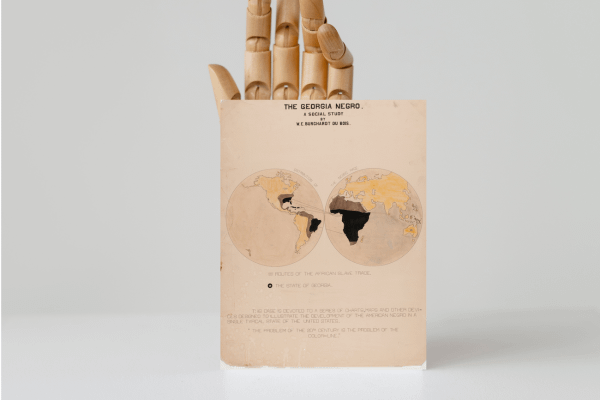
Deconstructing Power: W.E.B. Du Bois at the 1900 World’s Fair places decorative arts from Cooper Hewitt’s permanent collection in dialogue with 20 innovative data visualizations that W.E.B. Du Bois (1868–1963) created for the 1900 Paris World’s Fair to explore how design can both reveal and mask dynamics of power and equity.
Forty-seven countries participated in the 1900 Paris World’s Fair, each attempting to demonstrate to a global audience its cultural and economic progress through carefully crafted installations of the latest in art, imported materials, and cutting-edge innovations. For the Exhibit of American Negroes, Du Bois and his Atlanta University students made 63 hand-drawn diagrams that used shape, line, and color to showcase the success Black Americans had achieved despite facing pervasive racism in the United States and the global community. The data visualizations were created on presentation cardboard and conceived for a temporary installation at the fair. Given their fragile nature, the works will be rotated during the course of the exhibition.
This exhibition highlights these groundbreaking data visualizations, on loan from the Library of Congress, and, for the first time, will bring them into dialogue with the manufacturers and decorative arts also on display at the fair. Examples by Sèvres, Louis Comfort Tiffany, and Emile Gallé illuminate how national styles were crafted; these examples also prompt a continued investigation of what and who defines a nation. Works by Carlo Bugatti, Adolf Loos, and Henry van de Velde call for deeper exploration of the imperial fantasies permeating modern design at the turn of the century. (Source)
Exhibition runs through May 29th, 2023, view full details on Cooper Hewitt’s website.
About W.E.B. Du Bois
W.E.B. Du Bois was an American sociologist, historian, civil rights activist, Pan-Africanist, author, editor, and socialist. He was a co-founder of the National Association for the Advancement of Colored People (NAACP) and the National Urban League. He is best known for his book The Souls of Black Folk, which is considered a classic of African-American literature. Born in Great Barrington, Massachusetts, in 1868, He attended Fisk University in Nashville, Tennessee, and Harvard University, where he was the first African American to earn a doctorate. After graduating from Harvard, Du Bois taught at Atlanta University, where he founded the Atlanta Sociological Laboratory.
Du Bois was a vocal critic of racism and segregation. He believed that African Americans could achieve full equality only through education, economic empowerment, and political activism. He was also a strong supporter of Pan-Africanism, the belief that all people of African descent should unite to fight for their rights. Well known as a controversial figure throughout his life, he was often criticized for his socialist views and his support of Pan-Africanism. However, he was also praised by many for his commitment to social justice and his work on behalf of African Americans.
Du Bois died in 1963 at the age of 95, and is considered one of the most important figures in the history of the civil rights movement. He was a complex and controversial figure, but he was also a tireless advocate for social justice. His work has had a lasting impact on the civil rights movement and on the lives of African Americans.
Comments are closed.